Monday, 11 July 2011


PHOTOS - Plastic Injection Mold / Mould...

PLASTIC INJECTION MOLD WHICH IS FINISHED AND READY FOR PACKAGING AND EXPORTING

PLASTIC INJECTION MOLD WHICH IS FOR - BOTTLE CAP

LARGE PLASTIC INJECTION MOLD WITH - HOT RUNNER TECHNOLOGY

LARGE PLASTIC INJECTION MOLD ON - SIDE VIEW

PLASTIC INJECTION MOLD - BEFORE ASSEMBLED

PLASTIC INJECTION MOLD - WITH 4 SIDE CORE (SLIDER) TECHNOLOGY

PLASTIC INJECTION MOLD - IN OPENED CONDITION

PLASTIC INJECTION MOLD - FOR UPVC PIPE FITTING (CAVITY SIDE)

PLASTIC INJECTION MOLD - FOR UPVC PIPE FITTING (CORE SIDE)

PLASTIC INJECTION MOLD - NORMALLY B4 ASSEMBLE

PLASTIC INJECTION MOLD - CORE SIDE (ELECTRONIC PRODUCT)

PLASTIC INJECTION MOLD - MULTI CAVITY PLASTIC SPOON MOLD

PLASTIC INJECTION MOLD - FOR ONE CAR PART

PLASTIC INJECTION MOLD - MOBILE BACK COVER (CORE SIDE)
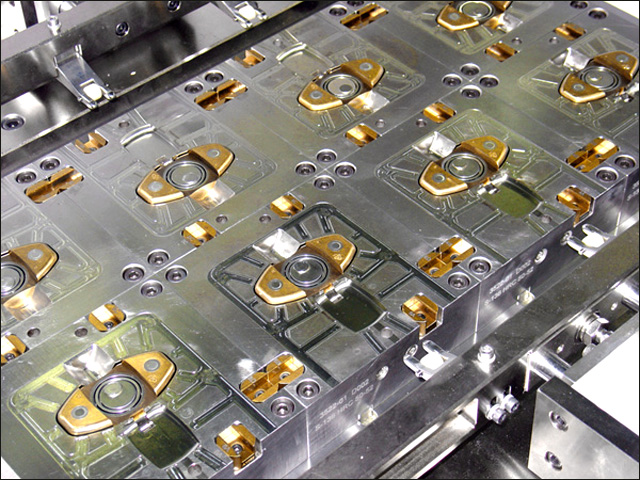
PLASTIC INJECTION MOLD - 1 BIKE PART (CORE SIDE)
Question &Ans:- Injection Molding Process - Introduction
Quest:-
What is plastic Injection molding?
Ans:-

What is plastic Injection molding?
Ans:-
Plastic injection molding starts with small pellets compounded to meet certain physical properties.
These pellets are then dried and fed into a hopper,
which allows them continuously dried and fed into the throat of the machine.
The machine them melts the plastic in a heated barrel,
and injects it under high pressure out of the barreland into your mold cavity.
The injected plastic quickly fills the cavity,
and it is then allowed to cool while the machine fills its barrel for the next cycle.
As the plastic cools, it changes back to a solid.
After a set amount of time, the mold opens, exposing the part, and hydraulic ejector pins push the part out of the cavity.

Question & Ans -about RAPID INJECTION MOLDING technology...
Although traditional rapid prototyping is still widely used, a growing number of engineers are turning to rapid injection molding for prototyping and short-run production...
QUEST:-
What’s the difference between rapid prototyping and rapid injection molding ?
ANS:-
While rapid prototyping and rapid injection molding both start with a 3D CAD part model, the actual processes and end results are very different. Rapid prototyping, which includes technologies like stereolithography, selective laser sintering, fused deposition modeling, laminated object manufacturing, and three-dimensional printing, creates a prototype layer by layer to form the end product. Rapid injection molding, on the other hand, uses the familiar process of injecting heated thermoplastics into a metal mold, where the material cools into the desired shape.
QUEST:-
What are the advantages of rapid injection molding?
ANS:-
Unlike rapid prototyping, rapid injection molding produces a fully functional, injection molded part. The resulting quality difference is so significant that many design engineers who test form and fit using rapid prototyping will still check the functionality of their prototypes using rapid injection molding. Also, while conventional mold making is very labor-intensive, rapid injection molding fully automates this step, typically reducing tooling cost and lead time by two-thirds.
QUEST:-
How does the rapid injection molding process work?
ANS:-
It’s a unique, highly automated method of producing injection molded parts from a 3D CAD part model. The core technology is proprietary software that automatically converts the part model into toolpaths for CNC milling machines. These, in turn, produce the mold components that, when assembled and mounted on an injection molding press, produce the desired part.
QUEST:-
How did rapid injection molding improve plastic housing?
ANS:-
Besides reducing the cost and delay of individually machining parts, the new injection-molded housing has a lot of advantages over what we were producing before. It’s much more compact, which is a big benefit for customers. Their research often requires placing the filled housings into controlled-environment chambers, so when we save them space, they get more research done faster.
QUEST:-
How much did it save?
ANS:-
Traditional injection molders gave quotes of about $25,000 (eg) and required months of lead time to produce a part. Rapid injection molding came in at around $4,000, and even with highly polished surface for enhanced cosmetics, something the other molders weren’t even quoting, it still cost us less than $5,800. And the parts can even shipped in 10 business days.
Thursday, 7 July 2011
History of Plastic Moulding???
History of Plastic Moulding

In 1868, perhaps in response to a request by billiard ball maker Phelan and Collander, John Wesley Hyatt invented a way to make billiard balls by injecting celluloid into a mould. By 1872, John and his brother Isaiah Hyatt patented the injection moulding machine. The machine was primitive yet it was quite suitable for their purposes. It contained a basic plunger to inject the plastic into a mould through a heated cylinder.
Revolutionizing the plastics industry in 1946, James Hendry built the first screw injection moulding machine with an auger design to replace Hyatt's plunger. The auger is placed inside the cylinder and mixes the injection material before pushing forward and injecting the material into the mould. Today, almost all injection moulding machines use this same technique.
What is PLASTIC molding / moulding?
Plastic moulding is the process of shaping plastic using a rigid frame or mould. The technique allows for the creation of objects of all shapes and sizes with huge design flexibility for both simple and highly complex designs.
Plastic Moulding Techniques:-
While there are many plastic moulding processes and techniques,some of them are rotational moulding, injection moulding, blow moulding, and compression moulding.
Plastics are synthetically produced non-metallic compounds. It can be molded into various forms and hardened for commercial use. Plastic molding products can be seen everywhere. Examples are jars, protective caps, plastic tubes, grips, toys, bottles, cases, accessories, kitchen utensils and a lot more
.
Even the keyboard and the mouse that you use are made through plastic molding. Even the plastic parts of the chair that you are sitting on are created this way.
The basic idea in plastic molding is inserting molten liquid plastic into a ready shaped mold, for example the mold of a bottle. It will be then allowed to cool, then the mold will be removed to reveal the plastic bottle.
Plastic molding can also custom-mold a wide variety of plastic products including: garden pots, cabinets, office trays and boxes, barriers, barricades and traffic signage.
The Plastic Molding Processes:
- Injection Molding In Injection Molding, melted plastic is forced into a mold cavity. Once cooled, the mold can be removed. This plastic molding process is commonly used in mass-production or prototyping of a product. Injection molding machines were made in the 1930’s. These can be used to mass produce toys, kitchen utensils, bottle caps, and cell phone stands to name a few.
- Blow Molding Blow molding is like injection molding except that hot liquid plastic pours out of a barrel vertically in a molten tube. The mold closes on it and forces it outward to conform to the inside shape of the mold. When it is cooled, the hollow part is formed. Examples of blow molding products are bottles, tubes and containers.
- Compression Molding In this type of plastic molding, a slug of hard plastic is pressed between two heated mold halves. Compression molding usually uses vertical presses instead of the horizontal presses used for injection and blow molding. The parts formed are then air-cooled. Prices of equipments used for compression molding are moderate.
- Film Insert Molding This plastic molding technique imbeds an image beneath the surface of a molded part. A material like film or fabric is inserted into a mold. Plastic is then injected.
- Gas Assist Molding Also called gas injection molding is used to create plastic parts with hollow interiors. Partial shot of plastic is then followed by high-pressure gas to fill the mold cavity with plastic
. - Rotational Molding Hollow molds packed with powdered plastic are secured to pipe-like spokes that extend from a central hub. The molds rotate on separate axes at once. The hub swings the whole mold to a closed furnace room causing the powder to melt and stick to the insides of the tools. As the molds turn slowly, the tools move into a cooling room. Here, sprayed water causes the plastic to harden into a hollow part. In this type of plastic molding, tooling costs are low and piece prices are high. Cycle time takes about 40-45 minutes.
- Structural Foam Molding Structural foam molding is a process of plastic molding usually used for parts that require thicker walls than standard injection molding. Inserting a small amount of nitrogen or chemical blow agent into the plastic material makes the walls thicker. Foaming happens as the melted plastic material enters the mold cavity. A thin plastic skin forms and solidifies in the mold wall. This type of plastic molding can be used with any thermoplastic that can be injection molded.
- Thermoforming In this plastic molding process, sheets of pre-extruded rigid plastics are horizontally heated and sucked down into hollow one-piece tools. When the hot plastic solidifies, its shape conforms to that of the mold.
Tooling costs are usually low and piece prices vary on the machinery.
Plastic molding is a very technical process. It needs experts in this type of manufacturing business for it to be competitive in the market. Therefore, a very scientific and systematic study should be first made before going into this endeavor.
MOLD / MOLDING...means???
Molding or moulding is the process of manufacturing by shaping pliable raw material using a rigid frame or model called a pattern.
A mold or mould is a hollowed-out block that is filled with a liquid like plastic, glass, metal, or ceramic raw materials. The liquid hardens or sets inside the mold, adopting its shape. A mold is the opposite of a cast. The manufacturer who makes the molds is called the moldmaker.
A mold or mould is a hollowed-out block that is filled with a liquid like plastic, glass, metal, or ceramic raw materials. The liquid hardens or sets inside the mold, adopting its shape. A mold is the opposite of a cast. The manufacturer who makes the molds is called the moldmaker.
Subscribe to:
Posts (Atom)